<?xml version="1.0" encoding="utf-8"?><feed xmlns="http://www.w3.org/2005/Atom" ><generator uri="https://jekyllrb.com/" version="3.10.0">Jekyll</generator><link href="https://gt-hcai.github.io/feed.xml" rel="self" type="application/atom+xml" /><link href="https://gt-hcai.github.io/" rel="alternate" type="text/html" /><updated>2026-11-17T07:59:52+00:00</updated><id>https://gt-hcai.github.io/feed.xml</id><title type="html">HCAI Working Group</title><subtitle>An amazing website.</subtitle><author><name> </name></author><entry><title type="html">2026 GT Human-centered AI Day</title><link href="https://gt-hcai.github.io/hcai-annual-event-2026/" rel="alternate" type="text/html" title="2026 GT Human-centered AI Day" /><published>2026-09-21T00:00:00+00:00</published><updated>2026-09-21T00:00:00+00:00</updated><id>https://gt-hcai.github.io/hcai-annual-event-2026</id><content type="html" xml:base="https://gt-hcai.github.io/hcai-annual-event-2026/"><![CDATA[<p><strong>24 November 2026 – Hybrid Event (Sorbonne Université, Paris &amp; Online)</strong> <br />
<em>Organized by the HCAI Working Group of the GDR IHM.</em></p>

<p>We are pleased to announce our 2nd annual one-day workshop dedicated to exploring current research in Human-Centred AI (HCAI) in France. This event brings together researchers, practitioners, and students interested in designing and understanding AI systems that place humans at the center.</p>

<p>This year event is dedicated to <strong>researching across and between disciplines</strong>. We will explore the challenges that come up in human-centred AI when different fields meet, such as artificial intelligence, design, anthropology, systems engineering, law, and cognitive sciences (among others).</p>

<p>The program features: <strong>keynote talks</strong> by Gonzalo Ramos and Gabrielle Benabdallah and <strong>research presentations</strong> followed by discussions.</p>

<h3 id="attendance">Attendance</h3>

<p>This workshop will be held in <strong>hybrid format</strong>, welcoming participants both:</p>

<ul>
  <li><strong>In person (registration required)</strong> at the Institute for Institute for Intelligent Systems and Robotics (ISIR), Sorbonne Université, Paris (<a href="#access">see access map below</a>)</li>
  <li><strong>Online via Zoom</strong>, for those unable to travel (Zoom link: <a href="https://univ-lille-fr.zoom.us/j/95432959209">https://univ-lille-fr.zoom.us/j/95432959209</a>)</li>
</ul>

<h3 id="program">Program</h3>

<table>
  <tbody>
    <tr>
      <td>09:30</td>
      <td><span style="color:gray">Coffee (in the workshop Room)</span></td>
    </tr>
    <tr>
      <td>10:00</td>
      <td>Welcome by Baptiste Caramiaux &amp; Janin Koch</td>
    </tr>
    <tr>
      <td>10:15</td>
      <td><strong>Keynote 1: Gonzalo Ramos</strong> - <em>Human-Centered AI: What (I think) it is, where it is at, and where we can take it</em></td>
    </tr>
    <tr>
      <td>11:00</td>
      <td><span style="color:gray">Break</span></td>
    </tr>
    <tr>
      <td>11:20</td>
      <td>Human movement analysis, Machine Learning</td>
    </tr>
    <tr>
      <td>12:00</td>
      <td>Human-AI Collaboration and Artistic Practice</td>
    </tr>
    <tr>
      <td>12:40</td>
      <td><span style="color:gray">Lunch served for registered participants</span></td>
    </tr>
    <tr>
      <td>14:00</td>
      <td>Group activity</td>
    </tr>
    <tr>
      <td>14:15</td>
      <td><strong>Keynote 2: Gabrielle Benabdallah</strong> - <em>Writing as Material Practice in the Age of Language Models</em></td>
    </tr>
    <tr>
      <td>15:00</td>
      <td><span style="color:gray">Break</span></td>
    </tr>
    <tr>
      <td>15:20</td>
      <td>Specialized work</td>
    </tr>
    <tr>
      <td>16:00</td>
      <td>Agency, specialized work</td>
    </tr>
    <tr>
      <td>16:40</td>
      <td><span style="color:gray">Break</span></td>
    </tr>
    <tr>
      <td>17:00</td>
      <td>Final discussion and conclusions</td>
    </tr>
    <tr>
      <td>18:00</td>
      <td><span style="color:gray">End / afterwork</span></td>
    </tr>
  </tbody>
</table>

<h3 id="presentation-details">Presentation details</h3>

<p>Soon</p>

<h3 id="keynote-details">Keynote details</h3>

<h4 id="keynote-1-gonzalo-ramos-director-of-research-cnrs-sorbonne-université">Keynote 1: Gonzalo Ramos (Director of Research, CNRS, Sorbonne Université)</h4>

<p><img src="/assets/imgs/hcai-day-2026/gonzalo-ramos.jpg" alt="alt text" title="headshot Gonzalo" /></p>

<p><strong>Human-Centered AI: What (I think) it is, where it is at, and where we can take it</strong></p>

<p><em>As HCI researchers, we often use the term human-centered to describe what we do, how we do it, and why. Human-centeredness is a philosophy of practice that we all come to from different places and that we approach differently: there are many humans and centers one can have in mind. Despite its fluidity, or perhaps because of it, the HCI family of practices has played a significant part in the ideation, critique and development of many important technological advances. Today, with the emergence, rapid development, and deployment of AI technologies that can affect people and society in profound ways, the concept and practice of being human-centered is more important than ever.</em>
<em>In this talk, I would like to share my perspective on what it means to be human-centered in our practice, what we (or I) mean when we (I) use the term human-centered AI, and what research priorities in this area can look like. I will first reflect on my work as it has progressively focused on evolving computational and interactive substrates (from pen computing and direct manipulation to machine learning and genAI), and how it has shaped my understanding of what being human-centered in our practice is. I will then share insights from recent work in which we interviewed 10 HCI practitioners about what human-centered machine learning (HCML) and AI mean to them, and what they mean for our practice. Finally, I will present some research priorities that resonate with me and that I hope help bring into focus what meaningful and durable human-centered AI topics can look like.</em></p>

<p><a href="https://inputdesignoutput.com/gonzalo/">Gonzalo Ramos</a> is Director of Research at CNRS, Sorbonne Université</p>

<h4 id="keynote-2-gabrielle-benabdallah">Keynote 2: Gabrielle Benabdallah</h4>

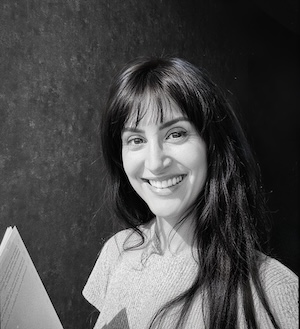
<p><img src="/assets/imgs/hcai-day-2026/Benabdallah_headshot.jpg" alt="alt text" title="headshot Gabrielle" /></p>

<p><strong>Writing as Material Practice in the Age of Language Models</strong></p>

<p><em>In this talk, I discuss large language models as the latest in a line of writing technologies that runs from the clay tokens of ancient Mesopotamia to the GPT tokens sold by the million today, and ask what that material history can teach us about designing convivial approaches to language models. To engage this question, I draw on interpretability research, which studies the internal representations of language models, and on computational poetics to argue that these representations constitute a formal materiality that can be worked as an expressive material. I share early experiments that use a model’s internal activations to compose, among other things, poetry, and show how such representations of a model’s hidden layers can support both creative practices and the goals of interpretability, by making the complex operations inside these models something people can experience. The goal of this project is to open the surface of language models to interpretation, intervention, and possibly, reconfiguration.</em></p>

<p><a href="https://poeticmachine.com/">Gabrielle Benabdallah</a> is a Postdoctoral fellow at University of Washington</p>

<h3 id="access-map">Access map</h3>

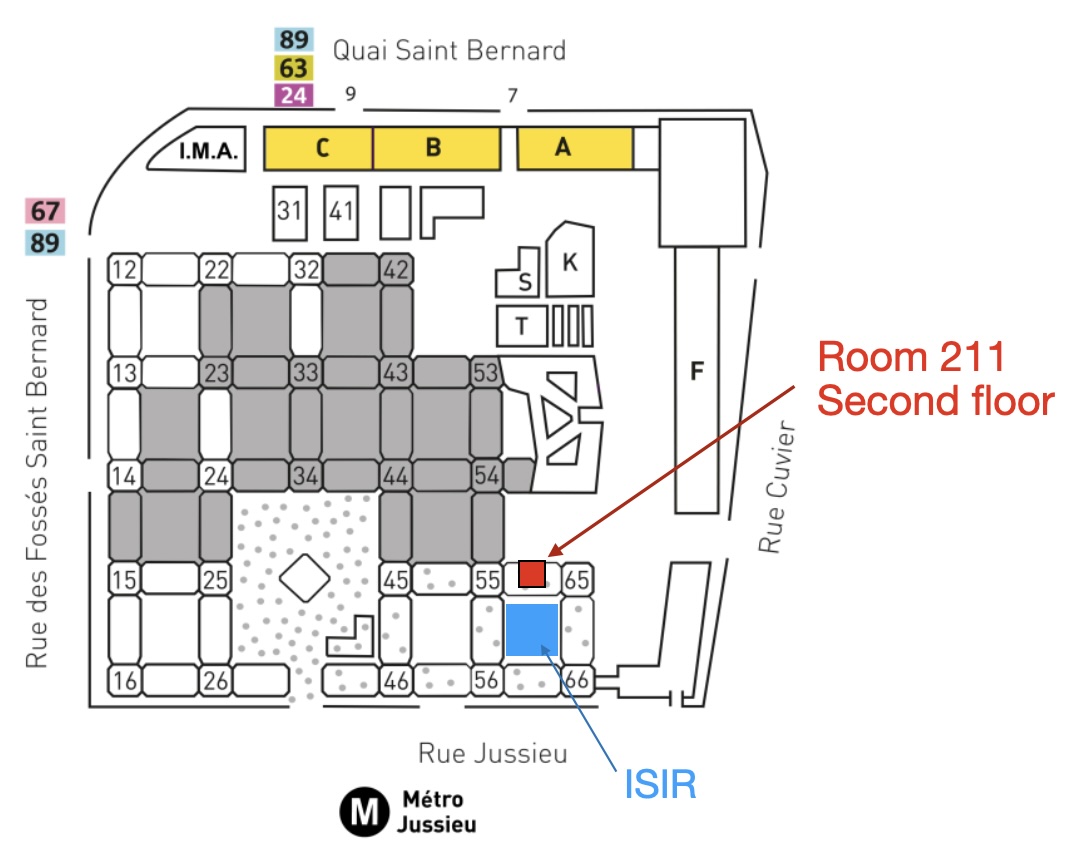
<p>The event will take place at ISIR, in <strong>room 211</strong> (between towers 55 and 65, see map below).</p>

<p>Lunch will be served in the same room.</p>

<p><img src="/assets/imgs/hcai-day-2026/su_access_map_2026_hcai_day.jpg" alt="alt text" title="Access Map" /></p>

<h3 id="acknowledgements">Acknowledgements</h3>

<p>The organization of this event was supported by CNRS, Sorbonne Université, ISIR (Institute for Intelligent Systems and Robotics).</p>]]></content><author><name> </name></author><summary type="html"><![CDATA[This is the second annual event of the HCAI WG]]></summary></entry><entry><title type="html">HCAI Session at the GDR IHM Days</title><link href="https://gt-hcai.github.io/hcai-session-gdrihm/" rel="alternate" type="text/html" title="HCAI Session at the GDR IHM Days" /><published>2026-07-09T10:00:00+00:00</published><updated>2026-07-09T10:00:00+00:00</updated><id>https://gt-hcai.github.io/hcai-session-gdrihm</id><content type="html" xml:base="https://gt-hcai.github.io/hcai-session-gdrihm/"><![CDATA[<p>We’re happy to invite you to our upcoming HCAI (Human-Centered AI) Working Group session during the <a href="https://gdr-ihm.cnrs.fr/journees-gdr-ihm-2026/">GDR IHM annual event</a>.</p>

<p>General Information:</p>
<ul>
  <li><em>When</em>: 9 July 2026, 9h30 to 12h</li>
  <li><em>Where (in person)</em>: 20, avenue George Sand, 93210 La Plaine St-Denis</li>
  <li><em>Where (online)</em>: (ask us via <a href="https://gt-hcai.github.io/about/#contact">email</a>)</li>
</ul>

<p>The aim of this session is to identify, discuss, and organize the major challenges related to HCAI in HCI. On this page, we will report the outcome of the workshop.</p>

<h3 id="slides-of-the-presentation">Slides of the presentation</h3>

<iframe src="https://docs.google.com/presentation/d/1Z7JShAuRsyfHKzaTKWrd_INwN91AbZtfHcNiboM1n68/embed?start=false&amp;loop=false&amp;delayms=3000" width="120%" height="500px" frameborder="0" allowfullscreen=""></iframe>]]></content><author><name> </name></author><summary type="html"><![CDATA[Workshop]]></summary></entry><entry><title type="html">PEPR eNSEMBLE Design-A-Thon</title><link href="https://gt-hcai.github.io/designathon/" rel="alternate" type="text/html" title="PEPR eNSEMBLE Design-A-Thon" /><published>2026-06-15T10:00:00+00:00</published><updated>2026-06-15T10:00:00+00:00</updated><id>https://gt-hcai.github.io/designathon</id><content type="html" xml:base="https://gt-hcai.github.io/designathon/"><![CDATA[<h1 id="summer-school--15-to-19-june-université-paris-saclay">Summer School — 15 to 19 June, Université Paris-Saclay</h1>

<p>As mentioned during the TransNumériques in February, PEPR eNSEMBLE, together with the DINUM teams responsible for La Suite Numérique, will be organising a first “Design-A-Thon” summer school for PEPR PhD students and postdocs from 15 to 19 June at Université Paris-Saclay.</p>

<p>Ph.D. students will learn about the current research in the design of interactive tools based on Grounded Theories of Interaction. In addition to lectures from guest faculty in HCI and design, participants will work together in groups to demonstrate novel interaction ideas for <em>La Suite Numérique</em> – the French government’s open-source suite of interconnected collaborative applications, including a text editor, spreadsheet/database, video conferencing system and chat.</p>

<p>Participants will work with expert coaches during the week, with daily checkpoints. The final project will take the form a video prototype that demonstrates a novel form of interaction with one or more applications within the <em>Suite Numérique</em>.
Each group will present their project to a jury composed of HCI and design faculty and representatives of <em>La Suite Numérique</em>.</p>

<h2 id="practical-information">Practical information</h2>

<p>The intensive week begins Monday 15 June and ends Friday 19 June. Students are expected to stay on campus to encourage ongoing collaboration. Students with an eNSEMBLE PhD grant or mobility grant should use this funding primarily to cover transport costs; accommodation will be provided free of charge to participants.</p>

<p>Registration is required to allow us to make a group hotel booking and offer meals throughout the week.</p>

<p>More information and a provisional programme are available here: <a href="https://pepr-ensemble.fr/design-a-thon/DesignaThon.pdf">https://pepr-ensemble.fr/design-a-thon/DesignaThon.pdf</a></p>

<h2 id="registration">Registration</h2>

<p>We are sorry for this late notice. Nevertheless, please complete the pre-registration form as soon as possible, and by <strong>14 May</strong> at the latest. 
Please answer even if you cannot take part — it will only take 10 seconds: <a href="https://sondages.lisn.upsaclay.fr/PEPR-eNSEMBLE/index.php/315117?lang=en">https://sondages.lisn.upsaclay.fr/PEPR-eNSEMBLE/index.php/315117?lang=en</a></p>

<p>We look forward to welcoming you to Saclay very soon!</p>]]></content><author><name> </name></author><summary type="html"><![CDATA[Summer School]]></summary></entry><entry><title type="html">2025 GT Human-centered AI Day</title><link href="https://gt-hcai.github.io/hcai-annual-event-2025/" rel="alternate" type="text/html" title="2025 GT Human-centered AI Day" /><published>2025-11-25T10:00:00+00:00</published><updated>2025-11-25T10:00:00+00:00</updated><id>https://gt-hcai.github.io/hcai-annual-event-2025</id><content type="html" xml:base="https://gt-hcai.github.io/hcai-annual-event-2025/"><![CDATA[<p><img src="/assets/imgs/hcai-wrkshop-2025-featuredimg-b.png" alt="" style="width: 100%; text-align: center;" /></p>

<p><strong>25 November 2025 – Hybrid Event (Paris &amp; Online)</strong> <br />
<em>Organized by the HCAI Working Group of the GDR IHM.</em></p>

<p>We are pleased to announce a one-day workshop dedicated to exploring current research in Human-Centred AI (HCAI) in France. This event brings together researchers, practitioners, and students interested in designing and understanding AI systems that place humans at the center.</p>

<p>The program features: <strong>keynote talks</strong> by Wendy Mackay and Jules Françoise, <strong>research presentations</strong> covering diverse aspects of HCAI and <strong>live demonstrations</strong> of emerging technologies and systems.</p>

<p>The workshop aims to generate three outcomes: a  map of current HCAI research in France that highlights active themes; a list of funding opportunities through which new HCAI projects can be developed; and a set of concrete actions that the working group will pursue to structure future activities in this research area.</p>

<h3 id="attendance">Attendance</h3>

<p>This workshop will be held in <strong>hybrid format</strong>, welcoming participants both:</p>

<ul>
  <li><strong>In person</strong> at the Institute for Institute for Intelligent Systems and Robotics (ISIR), Sorbonne Université, Paris (<a href="#access">see access map below</a>)</li>
  <li><strong>Online via Zoom</strong>, for those unable to travel (<a href="https://cnrs.zoom.us/j/91521880919?pwd=ZWGTVV3CrRCWakwqBKs9gvGbN0Pqq5.1">Zoom link</a>)</li>
</ul>

<h3 id="program">Program</h3>

<table>
  <tbody>
    <tr>
      <td>09:30</td>
      <td><span style="color:gray">Coffee (in the workshop Room)</span></td>
    </tr>
    <tr>
      <td>10:00</td>
      <td><a href="#intro-and-conclusion-slides">Welcome</a> by Baptiste Caramiaux &amp; Janin Koch</td>
    </tr>
    <tr>
      <td>10:30</td>
      <td><strong>Keynote 1: Wendy Mackay</strong> - <em>“Redefining our Relationship with Intelligent Systems”</em></td>
    </tr>
    <tr>
      <td>11:00</td>
      <td><span style="color:gray">Coffee (in the workshop Room)</span></td>
    </tr>
    <tr>
      <td>11:15</td>
      <td><a href="#presentation-details">Presentations</a> by <em>Anke Brock &amp; Jérémie Garcia</em>, <em>Jules Leguy</em>, <em>Théo Jourdan</em>, <em>Emilie Perreau</em>, <em>Linghao Zeng</em>, <em>Victor Ranguin et Emilie Jiang</em></td>
    </tr>
    <tr>
      <td>12:45</td>
      <td><span style="color:gray">Lunch served at ISIR for registered participants</span></td>
    </tr>
    <tr>
      <td>14:00</td>
      <td><strong>Keynote 2: Jules Françoise</strong> - <em>“Towards collective approaches to teaching machines with Interactive Machine Learning”</em></td>
    </tr>
    <tr>
      <td>14:30</td>
      <td><a href="#demonstration-details">Demos</a> by <em>Jules Françoise, Léo Chédin, Mihai Branga Peicu, Xiaohan Peng</em></td>
    </tr>
    <tr>
      <td>15:15</td>
      <td><span style="color:gray">Coffee (in the workshop Room)</span></td>
    </tr>
    <tr>
      <td>15:30</td>
      <td><a href="#presentation-details">Presentations</a> by <em>Xiao Xiao</em>, <em>Balthazar Bujard</em>, <em>Behnoosh Mohammadzadeh</em>, <em>Wiam Bensaid</em>, <em>Lenny Martinez</em></td>
    </tr>
    <tr>
      <td>16:45</td>
      <td><a href="#intro-and-conclusion-slides">Session</a> on collaboration and animations within the GT (with book presentation by Mohamed Chetouani)</td>
    </tr>
    <tr>
      <td>17:30</td>
      <td>Conclusions</td>
    </tr>
    <tr>
      <td>18:00</td>
      <td><span style="color:gray">End / afterwork</span></td>
    </tr>
  </tbody>
</table>

<h3 id="presentation-details">Presentation details</h3>

<table>
  <tbody>
    <tr>
      <td>Anke Brock &amp; Jérémie Garcia</td>
      <td>Human-centered AI for real-time safety critical systems</td>
      <td> </td>
    </tr>
    <tr>
      <td>Balthazar Bujard</td>
      <td>“Towards User-Customizable Interactive Music Systems”</td>
      <td> </td>
    </tr>
    <tr>
      <td>Behnoosh Mohammadzadeh</td>
      <td>“Sensemaking in User-Driven Auditing: a Human-Centered Approach to Machine Learning Evaluation”</td>
      <td> </td>
    </tr>
    <tr>
      <td>Emilie Perreau</td>
      <td>“Toward a Methodology for Analyzing Human–Generative AI Interactions: Reflections on a Heuristic Approach Applied to Systems Engineering”</td>
      <td> </td>
    </tr>
    <tr>
      <td>Jules Leguy</td>
      <td>“A protocol to study the impact of explainable AI on AI-assisted decision making”</td>
      <td> </td>
    </tr>
    <tr>
      <td>Lenny Martinez</td>
      <td>“From Documentary Practice to Representational Agency: Understanding How Generative AI Reshapes Photography”</td>
      <td> </td>
    </tr>
    <tr>
      <td>Linghao Zeng</td>
      <td>“Causal Machine Learning for Human Motion Analysis: From Observability to Inference, Prediction to Causation, and Knowledge to Action”</td>
      <td> </td>
    </tr>
    <tr>
      <td>Mohamed Chetouani</td>
      <td>“The Handbook on Human–AI Collaboration: Building a Shared Resource for Research and Practice”</td>
      <td> </td>
    </tr>
    <tr>
      <td>Théo Jourdan</td>
      <td>“Collaborative Training of Neural Sound Synthesis Models for Music”</td>
      <td> </td>
    </tr>
    <tr>
      <td>Victor Ranguin et Emilie Jiang</td>
      <td>“Sealy the Seal: Investigating Playful Companions for Productivity”</td>
      <td> </td>
    </tr>
    <tr>
      <td>Wiam Bensaid</td>
      <td>“Interactive Taekwondo Poomsae Correction through Pose Estimation and Generative Flow Field Visualization”</td>
      <td> </td>
    </tr>
    <tr>
      <td>Xiao Xiao</td>
      <td>“Resonant AI: Interactive Mirrors for Embodied Reflection and Emotional Awareness”</td>
      <td> </td>
    </tr>
  </tbody>
</table>

<h3 id="demonstration-details">Demonstration details</h3>

<table>
  <tbody>
    <tr>
      <td>Jules Françoise</td>
      <td>Marcelle: A Framework for Composing Interactive Machine Learning Workflows and Interfaces</td>
    </tr>
    <tr>
      <td>Léo Chédin</td>
      <td>Korai: An Interactive Generative Dance Model</td>
    </tr>
    <tr>
      <td>Mihai Branga Peicu</td>
      <td>Interactive Explanation of LLMs for Expert Users in Information Retrieval</td>
    </tr>
    <tr>
      <td>Xiaohan Peng</td>
      <td>Design with DesignPrompt: Sketching and Creating with Multimodal Generative Visual Tools</td>
    </tr>
  </tbody>
</table>

<h3 id="intro-and-conclusion-slides">Intro and conclusion slides</h3>

<iframe src="https://docs.google.com/presentation/d/1H2sVAIWUi3SJ5aVHdrWcWDxriysKXjYH72fcciK7Qu4/embed?start=false&amp;loop=false&amp;delayms=3000" width="120%" height="500px" frameborder="0" allowfullscreen=""></iframe>

<h3 id="access-map">Access map</h3>

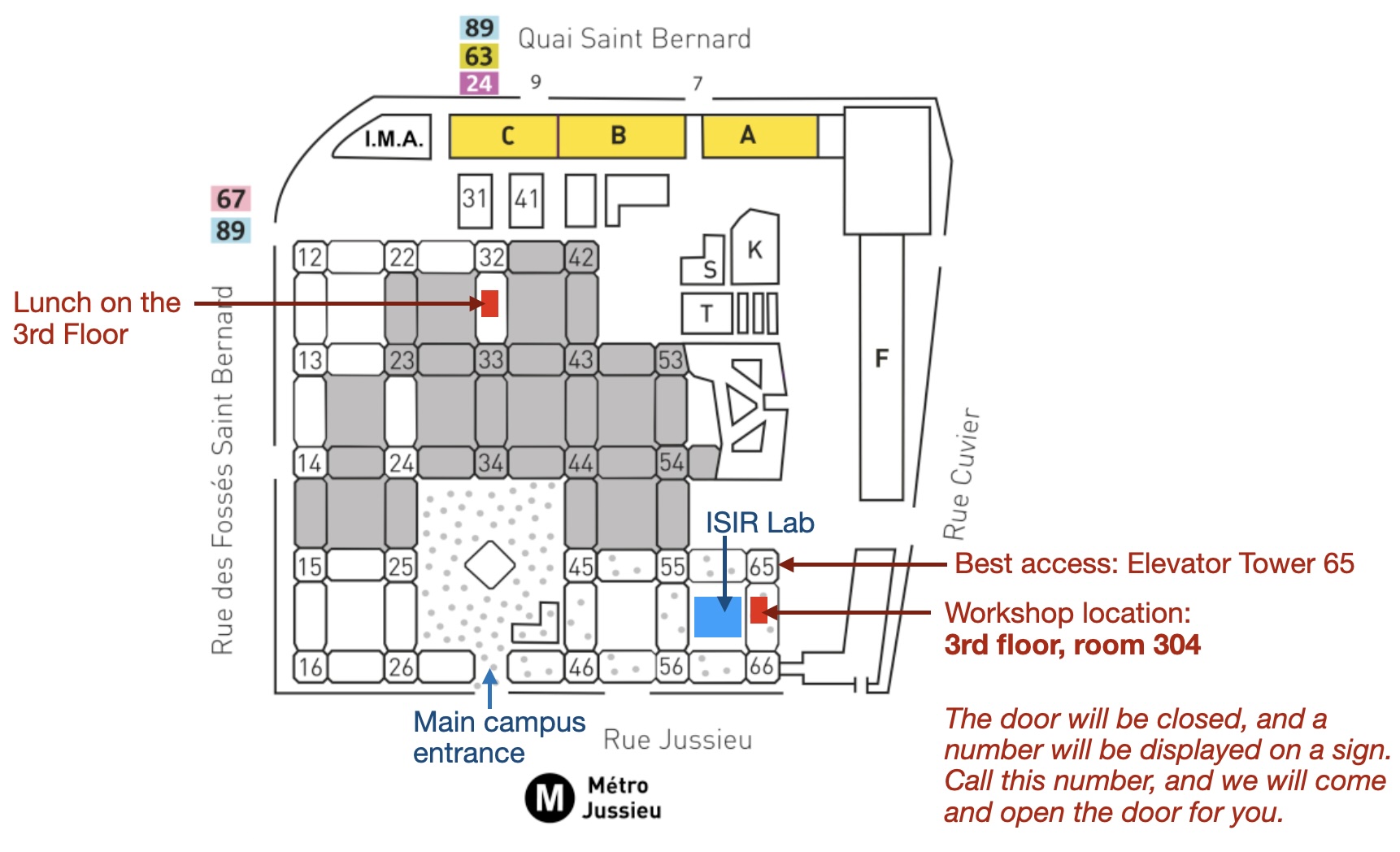
<p>The event will take place at ISIR, in <strong>room 304</strong> (between towers 65 and 66, see map below). Please take the evelator from tower 65. The corridor on the 3rd floor is closed and a number will be displayed on the door. <strong>Call this number</strong> and we will come and open the door for you.</p>

<p>Lunch will be served at the 3rd floor between towers 32 and 33.</p>

<p>Afterwork will take place at Césure, 13 rue Santeuil : <a href="https://cesure.paris/cantine/">https://cesure.paris/cantine/</a></p>

<p><img src="/assets/imgs/access_map_venue_hcai_workshop_2025.jpg" alt="alt text" title="Access Map" /></p>

<h3 id="acknowledgements">Acknowledgements</h3>

<p>The organization of this event was supported by CNRS, Sorbonne Université, ISIR (Institute for Intelligent Systems and Robotics) and SCAI (Sorbonne Centre for Artificial Intelligence). Special thanks to Axelle Jouvet (Université Grenoble-Alpes), Lenny Martinez (Sorbonne Université), Mihai Branga Peicu (Sorbonne Université) and Ziqi Yi (Sorbonne Université) for their help.</p>]]></content><author><name> </name></author><summary type="html"><![CDATA[This is the first annual event of the HCAI WG]]></summary></entry><entry><title type="html">Inauguration of the GDR IHM</title><link href="https://gt-hcai.github.io/inauguration/" rel="alternate" type="text/html" title="Inauguration of the GDR IHM" /><published>2025-07-03T10:00:00+00:00</published><updated>2025-07-03T10:00:00+00:00</updated><id>https://gt-hcai.github.io/inauguration</id><content type="html" xml:base="https://gt-hcai.github.io/inauguration/"><![CDATA[<p>We organized a half-day workshop, which took place on July 3, 2025 from 1:30 to 3:30 pm, as part of the inaugural day of the GDR IHM. The purpose of this half-day event was to discuss together the expectations of the working group on this theme, and how we should structure this working group to best support our community.</p>

<p>This half-day event was held face-to-face in Lyon, and online. The event was held in English. If you wish to attend in person, you must register for the GDR IHM inaugural day before Friday 20 June 2025. To prepare for this event, we prepared a quick survey (5min) that we invited participants to complete. This survey enabled us to find out whether you will attend the half-day event and, even if you don’t, to gather information for the GT.</p>

<h2 id="program">Program</h2>

<ul>
  <li>1:30 pm – 1:45 pm Presentation of the working group’s theme</li>
  <li>1:45 pm – 2:30 pm Presentation of participants (1 slide – 1 minute/person)</li>
  <li>2:30 pm – 3:00 pm Discussion of current survey results</li>
  <li>3:00 pm – 3:30 pm Open discussion</li>
</ul>]]></content><author><name> </name></author><summary type="html"><![CDATA[First meeting of the GT HCAI during the inauguration of the GDR IHM in Lyon]]></summary></entry></feed>