2026 GT Human-centered AI Day
24 November 2026 – Hybrid Event (Sorbonne Université, Paris & Online)
Organized by the HCAI Working Group of the GDR IHM.
We are pleased to announce our 2nd annual one-day workshop dedicated to exploring current research in Human-Centred AI (HCAI) in France. This event brings together researchers, practitioners, and students interested in designing and understanding AI systems that place humans at the center.
This year event is dedicated to researching across and between disciplines. We will explore the challenges that come up in human-centred AI when different fields meet, such as artificial intelligence, design, anthropology, systems engineering, law, and cognitive sciences (among others).
The program features: keynote talks by Gonzalo Ramos and Gabrielle Benabdallah and research presentations followed by discussions.
Attendance
This workshop will be held in hybrid format, welcoming participants both:
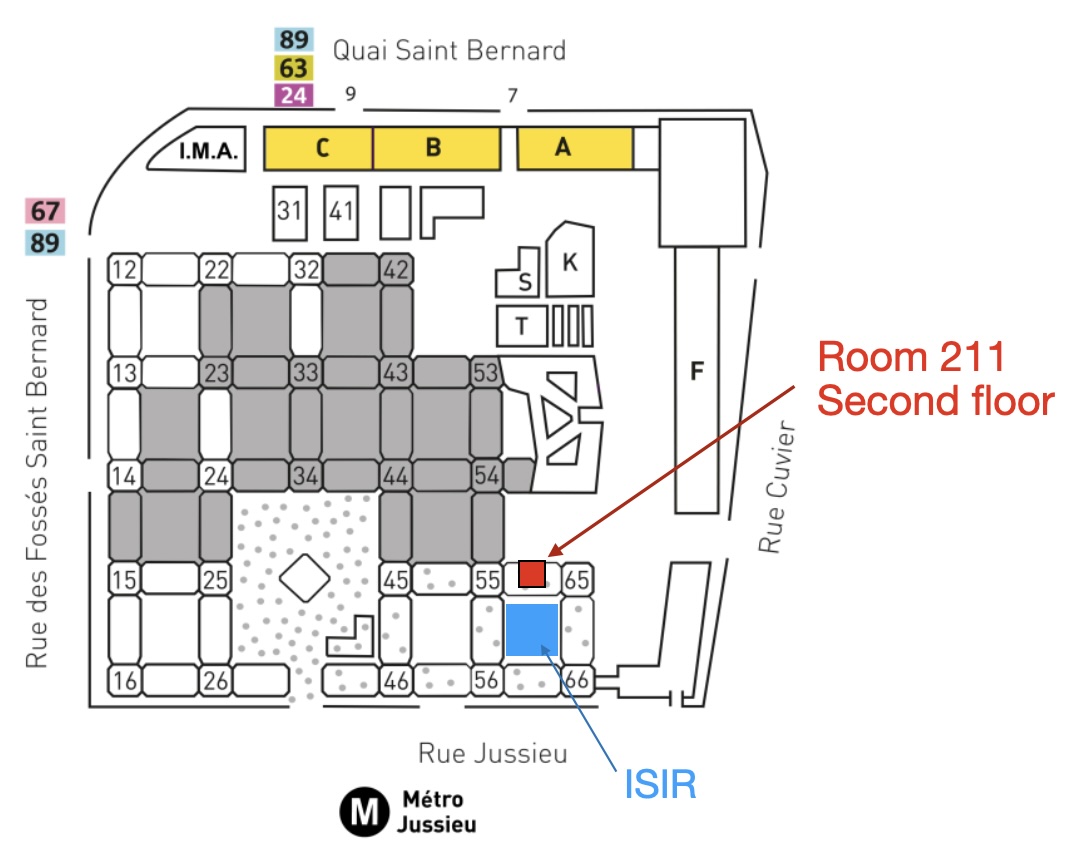
- In person (registration required) at the Institute for Institute for Intelligent Systems and Robotics (ISIR), Sorbonne Université, Paris (see access map below)
- Online via Zoom, for those unable to travel (Zoom link: https://univ-lille-fr.zoom.us/j/95432959209)
Program
| 09:30 | Coffee (in the workshop Room) |
| 10:00 | Welcome by Baptiste Caramiaux & Janin Koch |
| 10:15 | Keynote 1: Gonzalo Ramos Human-Centered AI: What (I think) it is, where it is at, and where we can take it |
| 11:00 | Break |
| 11:20 | Panel 1: Computer Vision for Analysing Human Action and Movement Alina Glushkova, Dimitrios Makrygiannis and Leina Montreuil |
| 12:00 | Panel 2: (Generative) AI as a Creative Medium Jérôme Nika, Balthazar Bujard and Xiaohan Peng |
| 12:40 | Lunch served for registered participants |
| 14:00 | Community resource activity |
| 14:15 | Keynote 2: Gabrielle Benabdallah Writing as Material Practice in the Age of Language Models |
| 15:00 | Break |
| 15:20 | Panel 3: Agency and Linguistic Factors in Human-Centred AI Bruno Berberian, Jules Françoise |
| 16:00 | Panel 4: Frictions and Power Relations in Human-Centred AI Janin Koch, Baptiste Caramiaux |
| 16:30 | Break |
| 16:50 | Group discussion on HCAI challenges |
| 18:00 | End / afterwork |
Keynote details
Keynote 1: Gonzalo Ramos

Human-Centered AI: What (I think) it is, where it is at, and where we can take it
As HCI researchers, we often use the term human-centered to describe what we do, how we do it, and why. Human-centeredness is a philosophy of practice that we all come to from different places and that we approach differently: there are many humans and centers one can have in mind. Despite its fluidity, or perhaps because of it, the HCI family of practices has played a significant part in the ideation, critique and development of many important technological advances. Today, with the emergence, rapid development, and deployment of AI technologies that can affect people and society in profound ways, the concept and practice of being human-centered is more important than ever. In this talk, I would like to share my perspective on what it means to be human-centered in our practice, what we (or I) mean when we (I) use the term human-centered AI, and what research priorities in this area can look like. I will first reflect on my work as it has progressively focused on evolving computational and interactive substrates (from pen computing and direct manipulation to machine learning and genAI), and how it has shaped my understanding of what being human-centered in our practice is. I will then share insights from recent work in which we interviewed 10 HCI practitioners about what human-centered machine learning (HCML) and AI mean to them, and what they mean for our practice. Finally, I will present some research priorities that resonate with me and that I hope help bring into focus what meaningful and durable human-centered AI topics can look like.
Gonzalo Ramos is Director of Research at CNRS, Sorbonne Université
Keynote 2: Gabrielle Benabdallah
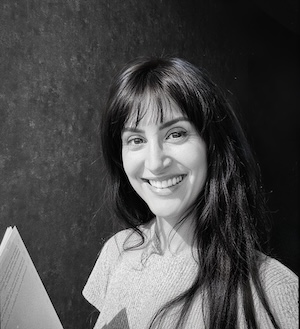
Writing as Material Practice in the Age of Language Models
In this talk, I discuss large language models as the latest in a line of writing technologies that runs from the clay tokens of ancient Mesopotamia to the GPT tokens sold by the million today, and ask what that material history can teach us about designing convivial approaches to language models. To engage this question, I draw on interpretability research, which studies the internal representations of language models, and on computational poetics to argue that these representations constitute a formal materiality that can be worked as an expressive material. I share early experiments that use a model’s internal activations to compose, among other things, poetry, and show how such representations of a model’s hidden layers can support both creative practices and the goals of interpretability, by making the complex operations inside these models something people can experience. The goal of this project is to open the surface of language models to interpretation, intervention, and possibly, reconfiguration.
Gabrielle Benabdallah is a Postdoctoral fellow at University of Washington
Access map
The event will take place at ISIR, in room 211 (between towers 55 and 65, see map below).
Lunch will be served in the same room.
Acknowledgements
The organization of this event was supported by CNRS, Sorbonne Université, ISIR (Institute for Intelligent Systems and Robotics).